Musical Lighter
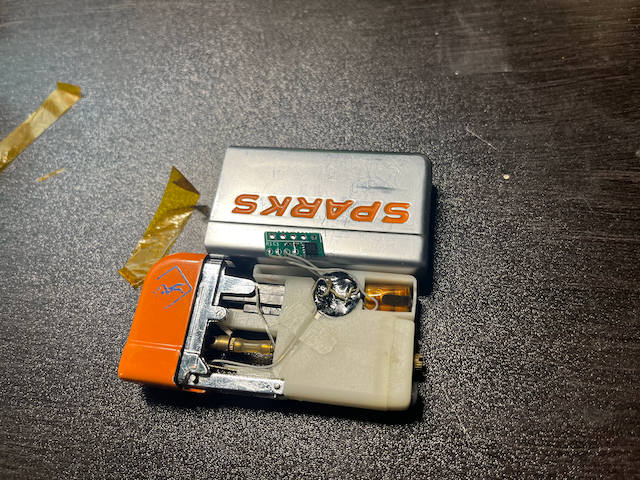
This project started when the original chip in my musical lighter died. After much research trying to find the original lighter again online without any success, I thought I'd try to replace the chip. The PCBA didn't have any markings, and the chip on it was black-epoxied over.
I first decided to try replacing it with an ATtiny85, but after lots and lots of hours sending code to a Digispark board I'd bought online, I ended up corrupting all of them, because they all rely on very unreliable flashing. After much more research, I landed on the PIC16F18313 in the UDFN package. This chip is an absolute pleasure to work with — it's pretty sturdy and doesn't need much to get it running. I installed a 10k pull-up on MCLRE and a decoupling capacitor. Looking back, I could've bought a programmer for the tinyAVR family, but I wanted to dip my toes into something new. Staying in the AVR family would've probably simplified the code side of this project.

I ended up running a jumper from one GND pad to another GND pad because of DRC constraints.
The code was written by Claude after many iterations. For some reason, the C compiler doesn't allow variable delays and needs delays calculated at compile time, so this code took a lot of tries. The song was pulled from robsoncouto's repo, arduino-songs. Code is at the end of the page.
// Cantina Band - PIC16F18313
// Buzzer on RA2, XC8 compiler
// Configuration: MCLRE=OFF, internal oscillator 32MHz

// PIC16F18313 Configuration Bit Settings

// 'C' source line config statements

// CONFIG1
#pragma config FEXTOSC = ECH    // FEXTOSC External Oscillator mode Selection bits (EC (external clock) above 8 MHz)
#pragma config RSTOSC = HFINT32 // Power-up default value for COSC bits (HFINTOSC with 2x PLL (32MHz))
#pragma config CLKOUTEN = OFF   // Clock Out Enable bit (CLKOUT function is disabled; I/O or oscillator function on OSC2)
#pragma config CSWEN = ON       // Clock Switch Enable bit (Writing to NOSC and NDIV is allowed)
#pragma config FCMEN = ON       // Fail-Safe Clock Monitor Enable (Fail-Safe Clock Monitor is enabled)

// CONFIG2
#pragma config MCLRE = OFF      // Master Clear Enable bit (MCLR/VPP pin function is digital input; MCLR internally disabled; Weak pull-up under control of port pin's WPU control bit.)
#pragma config PWRTE = ON       // Power-up Timer Enable bit (PWRT enabled)
#pragma config WDTE = OFF       // Watchdog Timer Enable bits (WDT disabled; SWDTEN is ignored)
#pragma config LPBOREN = OFF    // Low-power BOR enable bit (ULPBOR disabled)
#pragma config BOREN = ON       // Brown-out Reset Enable bits (Brown-out Reset enabled, SBOREN bit ignored)
#pragma config BORV = LOW       // Brown-out Reset Voltage selection bit (Brown-out voltage (Vbor) set to 2.45V)
#pragma config PPS1WAY = ON     // PPSLOCK bit One-Way Set Enable bit (The PPSLOCK bit can be cleared and set only once; PPS registers remain locked after one clear/set cycle)
#pragma config STVREN = ON      // Stack Overflow/Underflow Reset Enable bit (Stack Overflow or Underflow will cause a Reset)
#pragma config DEBUG = OFF      // Debugger enable bit (Background debugger disabled)

// CONFIG3
#pragma config WRT = OFF        // User NVM self-write protection bits (Write protection off)
#pragma config LVP = OFF        // Low Voltage Programming Enable bit (HV on MCLR/VPP must be used for programming.)

// CONFIG4
#pragma config CP = OFF         // User NVM Program Memory Code Protection bit (User NVM code protection disabled)
#pragma config CPD = OFF        // Data NVM Memory Code Protection bit (Data NVM code protection disabled)


#include <xc.h>
#include <stdint.h>
#include <stdlib.h>  // for abs()

#define _XTAL_FREQ   32000000UL
#define BUZZER_PIN LATAbits.LATA2
#define BUZZER_TRIS TRISAbits.TRISA2

// ---- Note definitions ----
#define REST      0
#define NOTE_B0   31
#define NOTE_C1   33
#define NOTE_CS1  35
#define NOTE_D1   37
#define NOTE_DS1  39
#define NOTE_E1   41
#define NOTE_F1   44
#define NOTE_FS1  46
#define NOTE_G1   49
#define NOTE_GS1  52
#define NOTE_A1   55
#define NOTE_AS1  58
#define NOTE_B1   62
#define NOTE_C2   65
#define NOTE_CS2  69
#define NOTE_D2   73
#define NOTE_DS2  78
#define NOTE_E2   82
#define NOTE_F2   87
#define NOTE_FS2  93
#define NOTE_G2   98
#define NOTE_GS2  104
#define NOTE_A2   110
#define NOTE_AS2  117
#define NOTE_B2   123
#define NOTE_C3   131
#define NOTE_CS3  139
#define NOTE_D3   147
#define NOTE_DS3  156
#define NOTE_E3   165
#define NOTE_F3   175
#define NOTE_FS3  185
#define NOTE_G3   196
#define NOTE_GS3  208
#define NOTE_A3   220
#define NOTE_AS3  233
#define NOTE_B3   247
#define NOTE_C4   262
#define NOTE_CS4  277
#define NOTE_D4   294
#define NOTE_DS4  311
#define NOTE_E4   330
#define NOTE_F4   349
#define NOTE_FS4  370
#define NOTE_G4   392
#define NOTE_GS4  415
#define NOTE_A4   440
#define NOTE_AS4  466
#define NOTE_B4   494
#define NOTE_C5   523
#define NOTE_CS5  554
#define NOTE_D5   587
#define NOTE_DS5  622
#define NOTE_E5   659
#define NOTE_F5   698
#define NOTE_FS5  740
#define NOTE_G5   784
#define NOTE_GS5  831
#define NOTE_A5   880
#define NOTE_AS5  932
#define NOTE_B5   988
#define NOTE_C6   1047
#define NOTE_CS6  1109
#define NOTE_D6   1175
#define NOTE_DS6  1245
#define NOTE_E6   1319
#define NOTE_F6   1397
#define NOTE_FS6  1480
#define NOTE_G6   1568
#define NOTE_GS6  1661
#define NOTE_A6   1760
#define NOTE_AS6  1865
#define NOTE_B6   1976
#define NOTE_C7   2093
#define NOTE_CS7  2217
#define NOTE_D7   2349
#define NOTE_DS7  2489
#define NOTE_E7   2637
#define NOTE_F7   2794
#define NOTE_FS7  2960
#define NOTE_G7   3136
#define NOTE_GS7  3322
#define NOTE_A7   3520
#define NOTE_AS7  3729
#define NOTE_B7   3951
#define NOTE_C8   4186
#define NOTE_CS8  4435
#define NOTE_D8   4699
#define NOTE_DS8  4978

// ---- Melody ----
int tempo = 200;

const int melody[] = {
    NOTE_B4,-4, NOTE_E5,-4, NOTE_B4,-4, NOTE_E5,-4,
    NOTE_B4,8,  NOTE_E5,-4, NOTE_B4,8, REST,8,  NOTE_AS4,8, NOTE_B4,8,
    NOTE_B4,8,  NOTE_AS4,8, NOTE_B4,8, NOTE_A4,8, REST,8, NOTE_GS4,8, NOTE_A4,8, NOTE_G4,8,
    NOTE_G4,4,  NOTE_E4,-2,
    NOTE_B4,-4, NOTE_E5,-4, NOTE_B4,-4, NOTE_E5,-4,
    NOTE_B4,8,  NOTE_E5,-4, NOTE_B4,8, REST,8,  NOTE_AS4,8, NOTE_B4,8,
    NOTE_A4,-4, NOTE_A4,-4, NOTE_GS4,8, NOTE_A4,-4,
    NOTE_D5,8,  NOTE_C5,-4, NOTE_B4,-4, NOTE_A4,-4,
    NOTE_B4,-4, NOTE_E5,-4, NOTE_B4,-4, NOTE_E5,-4,
    NOTE_B4,8,  NOTE_E5,-4, NOTE_B4,8, REST,8,  NOTE_AS4,8, NOTE_B4,8,
    NOTE_D5,4, NOTE_D5,-4, NOTE_B4,8, NOTE_A4,-4,
    NOTE_G4,-4, NOTE_E4,-2,
    NOTE_E4,2, NOTE_G4,2,
    NOTE_B4,2, NOTE_D5,2,
    NOTE_F5,-4, NOTE_E5,-4, NOTE_AS4,8, NOTE_AS4,8, NOTE_B4,4, NOTE_G4,4,
};

// ---- Tone generation ----
// Bit-bang a square wave on RA2 for the given frequency and duration (ms)


// ?? Microsecond delay (software-calibrated, no hardware timer) ????????????????
//
// Inner loop timing at 32 MHz (8 MIPS, 1 instruction cycle = 0.125 µs):
//
//   _delay(5)           ? 5 instruction cycles  (guaranteed by XC8)
//   while(uint8_t--)    ? DECFSZ + BRA/GOTO = 3 instruction cycles overhead
//   ?????????????????????????????????????????????????????????????????????
//   Per iteration total =  8 instruction cycles = 1 µs  ?
//
// We use a uint8_t inner counter (not uint16_t) because the uint16_t decrement
// in XC8 costs ~7 cycles of overhead, which would break the calibration.
// Delays > 255 µs are handled by iterating the outer uint16_t counter.
//
static void delay_us(uint16_t us) {
    while (us > 0) {
        uint8_t chunk = (us > 255) ? 255 : (uint8_t)us;
        us -= chunk;
        while (chunk--) {
            _delay(5);   /* 5 cycles + DECFSZ/BRA 3 cycles = 8 cycles = 1 µs */
        }
    }
}

// ?? Millisecond delay (XC8 instruction-cycle delay, accurate) ?????????????????
static void delay_ms(uint16_t ms) {
    for (uint16_t i = 0; i < ms; i++) __delay_ms(1);
}

// ?? Tone generation ???????????????????????????????????????????????????????????
void tone(uint16_t freq, uint16_t duration_ms) {
    if (freq == 0) {
        delay_ms(duration_ms);
        return;
    }

    // half-period in µs: 500 000 / freq
    // e.g. B4 (494 Hz) ? 1012 µs,  E5 (659 Hz) ? 758 µs
    uint16_t half = (uint16_t)(500000UL / freq);

    // number of complete square-wave cycles to produce
    uint32_t cycles = (uint32_t)freq * duration_ms / 1000;

    for (uint32_t i = 0; i < cycles; i++) {
        BUZZER_PIN = 1;
        delay_us(half);
        BUZZER_PIN = 0;
        delay_us(half);
    }
}


// ---- Sleep ----
void goToSleep(void) {
    BUZZER_PIN = 0;
    SLEEP();
}

// ---- Main ----
void main(void) {
    BUZZER_TRIS = 0;
    BUZZER_PIN  = 0;
    ANSELA      = 0x00;   // all pins digital


    int notes     = sizeof(melody) / sizeof(melody[0]) / 2;
    int wholenote = (60000 * 2) / tempo;   // ms for a whole note

    for (int i = 0; i < notes * 2; i += 2) {

        int divider = melody[i + 1];
        int noteDuration;

        if (divider > 0) {
            noteDuration = wholenote / divider;
        } else {
            // dotted note = 1.5× the straight value
            noteDuration = wholenote / abs(divider);
            noteDuration = (noteDuration * 3) / 2;
        }

        // Play tone for 90 % of the note duration, then a 10 % silence gap.
        // This mirrors the Arduino behaviour:
        //   tone(pin, freq, noteDuration*0.9);  ? non-blocking on AVR
        //   delay(noteDuration);                ? full note timing
        //   noTone(pin);
        tone((uint16_t)melody[i],
             (uint16_t)(noteDuration * 9 / 10));   // 90 % tone

        delay_ms((uint16_t)(noteDuration / 10));    // 10 % gap
    }

    goToSleep();
}